Possessive Adjectives and Pronouns in Everyday Speech
The Vibe
My phone, your bag, this isn't my book
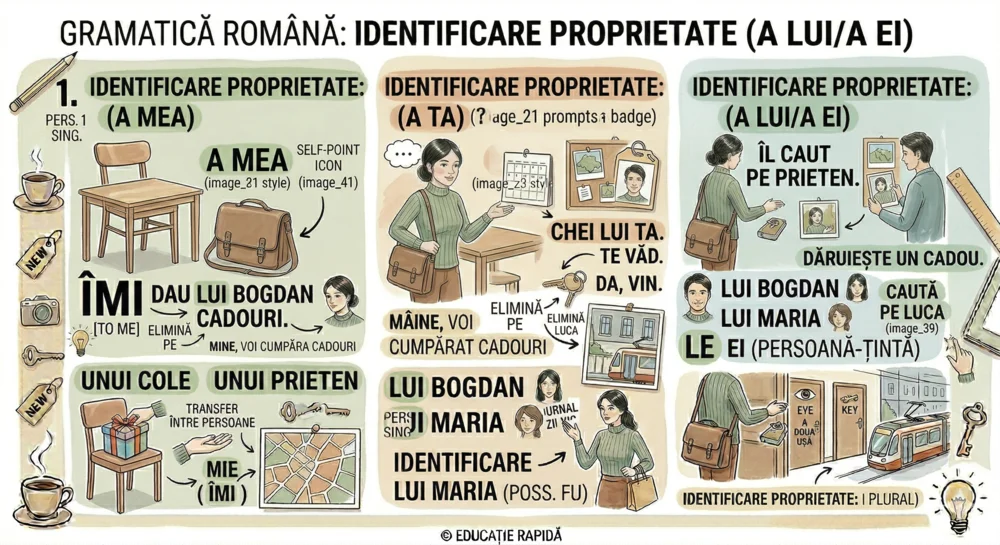
You are no longer talking only about an owner in general, but about your own things and other people's things. `A2_U10` makes possession language personal: `telefonul meu`, `cartea ta`, `geanta mea`, `este al meu`, `sunt ale mele`.
By the end of this unit you can
говорить о своих и чужих вещах через `meu / mea / tău / ta`
использовать притяжательные местоимения `al meu / a mea / ai mei / ale mele`
спрашивать и уточнять личную принадлежность предмета
строить короткие бытовые диалоги о личных вещах
Карта притяжательных форм
Это следующий слой языка принадлежности: уже не просто `чей предмет`, а `мой`, `твой`, `наш`, `не мой`.
Type
Form
Example
муж. ед.
meu / tău
telefonul meu, colegul tău
жен. ед.
mea / ta
cartea mea, geanta ta
местоимение м./ср.
al meu
Acesta este al meu.
местоимение ж.
a mea
Aceasta este a mea.
мн. ч.
ai mei / ale mele
Aceștia sunt ai mei. Acestea sunt ale mele.
Grammar Hack
Object first, possession second
At the start it is easier to learn chunks like `telefonul meu`, `geanta mea`, `cartea ta`.
The forms depend on gender and number
That is why it helps to keep a concrete noun nearby: book, bag, phone, friends.
`al meu / a mea` are perfect for answers
They are especially useful in short reactions: `Nu, nu este a mea.`
This is highly everyday language
Personal belongings, documents, room, desk, backpack, colleagues, family: all of that naturally pulls in possessives.
Learn through contrast
My / your / her / our are easiest to feel in neighboring contrastive examples.
Where the topic comes alive right away
personal belongings
The most natural scene is personal items in a room, classroom, cafe, or office.
Acesta este telefonul meu.
Unde este geanta ta?
Aceasta este cartea mea.
clarifying and answering
Possessive pronouns are especially useful when you need to answer quickly or deny ownership.
Nu, agenda nu este a mea.
Da, acestea sunt ale mele.
Aceștia sunt colegii mei.
Belongings and forms
telefonul meu
cartea mea
geanta ta
colegii mei
camera noastră
al meu
a mea
ai mei
ale mele
nu este
Ready-made phrases
Acesta este telefonul meu.
Aceasta este cartea mea.
Unde este geanta ta?
Nu, agenda nu este a mea.
Da, acestea sunt ale mele.
Nice to Know
Possessive forms sharply increase the everyday usefulness of the language: as soon as the learner can say `my phone`, `your bag`, `this is not mine`, the language becomes much more self-sufficient.
The Real Deal
●matching: object and possessive form
●sorting: adjective vs pronoun
●fill-in: `meu / mea / tău / ta`
●a mini dialogue about personal belongings and `it is mine / it is not mine`
Shadowing & Audio
Possessives work best as full ownership chunks: `telefonul meu`, `geanta ta`, `a mea`, `ale mele`, not as isolated pieces.
Flashcards
The unit flashcards are built around personal possession chunks and short answer forms.
Checkpoint
✓I can talk about my things and other people's things.
✓I can use `al meu / a mea / ale mele` in short answers.
✓I can build an everyday dialogue about personal ownership.
Flashcards
1 / 20
Acesta este telefonul meu.
this is my phone
Aceasta este cartea mea.
this is my book
Unde este geanta ta?
where is your bag?
Nu, agenda nu este a mea.
no, the planner is not mine
Da, acestea sunt ale mele.
yes, these are mine
telefonul meu
my phone
cartea mea
my book
geanta ta
your bag
a mea
mine
ale mele
mine (plural feminine / neuter)
Acesta este telefonul lui.
this is his phone
Aceasta este cartea ei.
this is her book
Aceasta este geanta noastră.
this is our bag
Aceasta este camera voastră.
this is your room
Aceasta este casa lor.
this is their house
al lui
his
a ei
hers
al nostru
ours (masculine)
a voastră
yours (feminine)
al lor
theirs (masculine)
Exercises
Adjective or Pronoun?
Sort the possessive forms by type.
telefonul meu
cartea mea
al meu
a mea
ale mele
Possessive Match
Match the object with the correct possessive phrase.
this is my phone
this is my book
where is your bag?
no, the notebook is not mine
Possessive Fill
Insert the correct possessive form.
telefonul ___
cartea ___
geanta ___
Nu, nu este a ___
Da, acestea sunt ale ___
Belongings Response
Read the cue and give a short possessive phrase.
this is our room
these are my colleagues
these keys are mine
Possessive Repair
Fix the lines: the possessive form is missing.
Acesta este telefon meu. Aceasta este cartea mea? Nu, nu este mea.
Possessive and Gender Agreement
Match the possessive form that agrees with the noun's gender.
my book (feminine)
my phone (masculine)
your notebook (masculine)
your bag (feminine)
his socks (plural)
Choose the Correct Possessive Form
Pick the form that agrees with the noun.
Acestea sunt creioanele ___?
Este asta cartea ___?
Aceștia sunt colegii ___.
Acestea sunt cheile ___.
Possessive in Context
Insert the correct possessive form in each sentence.
Casa ___ este lângă parcul mare.
Calculatorul ___ este vechi.
Pisica ___ este neagră și albă.
Apartamentul ___ se afă în centru.
Acestea sunt bagajele ___.
Mini Belongings Talk
Build a short talk about personal belongings.
1.Say which item is yours right now.
2.Say which item is not yours.
3.Say where your book or bag is.
Acesta este telefonul meu. Agenda nu este a mea. Geanta mea este pe scaun.