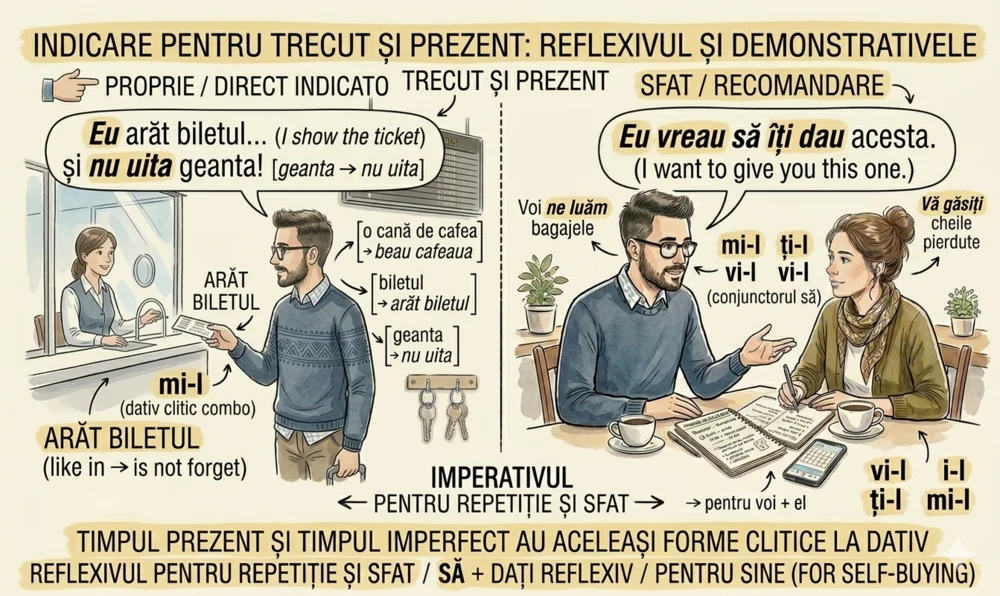
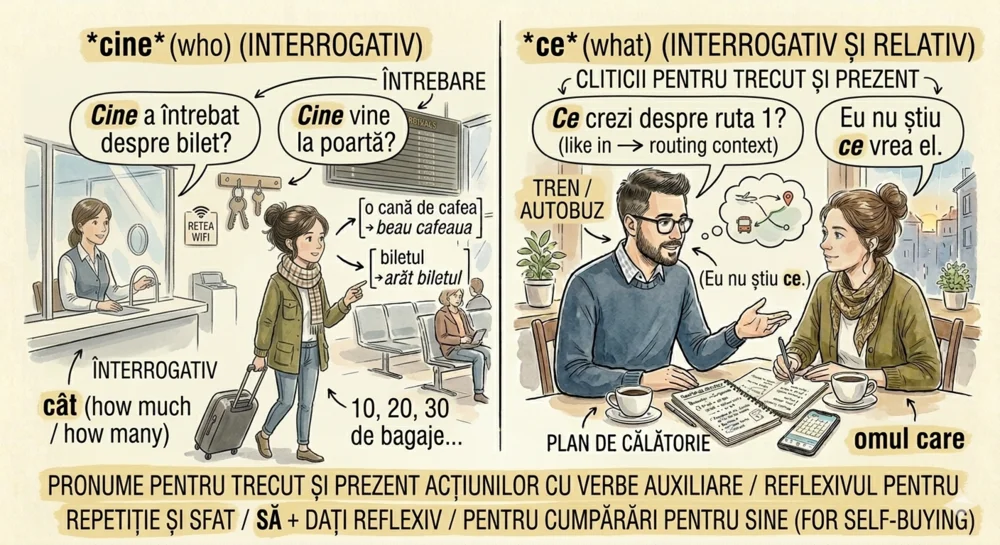
Relative and interrogative pronouns for clarification, linking, and precision
The Vibe
Who came, what changed, which option is better, how much time we have, and the person who said it
`B1_U08` gives the tools for more precise questions and more connected speech. The language stops being only short reply language and becomes better at linking people, things, options, and quantities inside one line.
By the end of this unit you can
ask more precisely about a person, thing, choice, and quantity
use `care` not only in a question but also as a linking element inside a sentence
build more connected explanations and clarification dialogues
hold the logic of `who / what / which / how much` inside a longer line
Where the topic becomes useful immediately
This topic is needed in clarification dialogues, explanations, choosing between options, and in lines where two parts of a sentence need to be linked without heavy repetition.
Function
Form
Example
кто
cine
Cine a venit mai devreme?
что
ce
Ce vrei să schimbi?
какой / который
care
Care este varianta mai bună?
сколько
cât
Cât timp ai?
относительная связка
care
Omul care stă acolo este profesorul meu.
Grammar Hack
These are not just question words
`care` matters especially as a linker: it connects description and reference.
The topic strengthens choice, comparison, and clarification: which train, which problem, how much time is left.
Listen to longer units
Here it matters to hear not one word, but the whole question or linked sentence.
A step toward more connected syntax
Speech becomes less chopped when these linking tools start working.
Question and linking inside the sentence
precise question
This is how the topic works for clarification.
Cine a venit?
Ce vrei să schimbi?
Care este varianta mai bună?
linked description
This is how the topic works for more mature connected speech.
Omul care stă acolo este profesorul meu.
Cartea care e pe masă nu este a mea.
Varianta care costă mai puțin nu este întotdeauna mai bună.
Core forms
cine
ce
care
cât
variantă
persoană
răspuns
timp
preț
drum
om
lucru
problemă
Ready-made phrases
Cine a venit mai devreme?
Ce vrei să schimbi?
Care este varianta mai bună?
Cât timp ai?
Omul care vorbește acum este profesorul meu.
Nice to Know
This is the point where question words stop being only question tools and become part of more mature, connected, and better-argued speech.
The Real Deal
●sorting: who / what / which / how much
●matching: сцена и точная логика вопроса
●fill-in: linked reference with `care`
●correction: fragmented speech becomes connected
●speaking: a clarifying mini dialogue with linked clauses
Full tasks and answer keys live in structured `exercises.json`.
Shadowing & Audio
Listening is noticeably denser here: the shadowing track includes not only short questions, but also linked `care`-clauses that need to be held as full units.
Flashcards
The flashcards stay dense, but what matters now is not only the form, but the logical role it plays in a question or a linking structure.
Checkpoint
✓I can distinguish `who`, `what`, `which`, and `how much` by function
✓I can use `care` to link inside a sentence
✓I can ask more precise and more mature questions
Flashcards
1 / 20
cine
who
ce
what
care
which / that
cât
how much / how long
variantă
option
persoană
person
răspuns
answer
timp
time
preț
price
drum
route / road
om
man / person
lucru
thing
problemă
problem
omul care
the person who
care vrea
who wants
cât de repede
how fast
care e diferența
what is the difference
omul care vorbește
the person who speaks
lucrul care se schimbă
the thing that changes
care era mai bun
which one was better
Exercises
Function Sort
Sort the forms by their interrogative function.
cine
ce
care
cât
cine a venit?
Question Match
Match the meaning with the precise question.
who came earlier?
what do you want to change?
which option is better?
how much time do you have?
Relative Fill
Insert the form that links or clarifies the sentence correctly.
Omul ___ vorbește acum este profesorul meu.
Cartea ___ e pe masă nu este a mea.
___ variantă vrei să alegi?
___ a spus asta mai întâi?
___ timp ne mai rămâne?
Logic Choice
Choose the form that better holds the logic of the question or the link.
who said it?: cine / cât
which train is better?: care / ce
the person who is standing there: omul ce / omul care
Linking Repair
Fix the lines so the question and the linking sound natural.
Omul ce stă aici este prietenul meu. Ce variantă este mai bună și cine timp avem?
Choose the Right Question
Select the interrogative or relative pronoun that fits.
___ ai venit mai devreme decât de obicei?
___ este responsabil de această decizie?
___ dintre variantele astea o prefeeri: roșie sau albă?
___ carte citești acum și pe ___ o recomandezi?
Cartea pe ___ o citeam ieri și cartea pe ___ o citesc azi nu sunt aceleași.
Sort by Function
Sort the pronouns by function: question about who/what, question about choice/quantity, or linking clauses.
cine a venit?
ce vrei?
care este mai bun?
cât timp?
omul care stă acolo
cartea care mi place
persoanele pe care le cunosc
ideea pe care o am
cât trebuie?
schimbul care se întâmplă
Clarifying Scene
Build a mini dialogue with questions and a linked clause.
1.Ask a question about a person.
2.Ask a question about an object or a change.
3.Clarify which option is better and how much time there is.
4.Add one linked line with `care`.
Cine a venit mai devreme? Ce vrei să schimbi? Care este varianta mai bună și cât timp avem? Omul care a sunat mai devreme este colegul meu.