plecasem
I had left
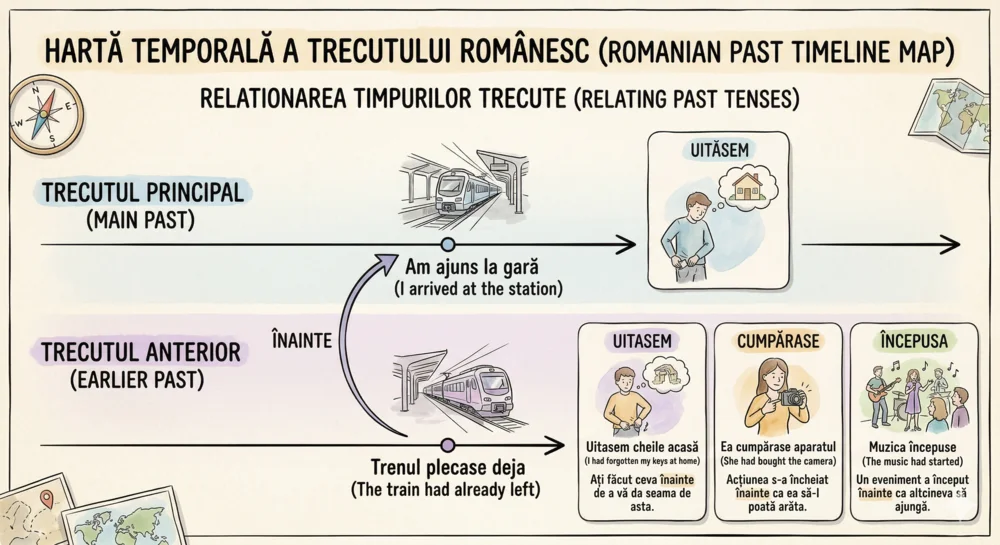
Mai mult ca perfectul: past before another past

The Vibe
`B2_U03` adds a second past timeline. You learn to explain not only what happened, but what had already happened before: `plecase`, `uitasem`, `cumpărase`.
First find the main past moment. Then ask: what had already happened before it? That is where `mai mult ca perfectul` appears.
| Form | Meaning | Example | Role |
|---|---|---|---|
| plecasem | I had left | Eu plecasem deja. | earlier past |
| verificaseși | you had checked | Tu verificaseși adresa. | preparation |
| ajunsese | he/she had arrived | Ea ajunsese înainte. | backstory |
| terminaserăm | we had finished | Noi terminaserăm discuția. | previous event |
| cumpăraserăți | you had bought | Voi cumpăraserăți biletele. | prior action |
| începuseră | they had started | Ei începuseră ședința. | already happened |
If your mind says `already`, you often need `plecase`, `începuse`, `cumpărase`.
`Când am ajuns...` sets the moment, then we explain what had already happened.
`Nu am găsit biletul pentru că îl pierdusem` explains the cause.
For B2, 2-3 earlier events are enough; otherwise the story gets heavy.
In conversation, people may use perfect compus, but this form is very useful for written clarity.
What happened in the past?
What had already happened before that moment?
Why does the reader need this earlier event?

Listen to the pairs and mark the main event vs earlier past. Repeat with a pause after `deja`.
10 tasks: form matching, timeline sorting, sequence repair, backstory writing, audio classification, and a mini-investigation.
Repeat in blocks: `Când am ajuns...`, `pentru că...`, `după ce...`. Make the earlier past sound like explanation, not a separate fact.
20 cards: forms, time markers, and ready backstory chunks.
Write an 8-10 line mini-investigation: 4 past events and at least 3 actions that had already happened earlier.
Match each pronoun with the correct pluperfect form.
Sort phrases: main event (perfect compus) or earlier event (pluperfect).
Fill in the correct pluperfect form.
Fix the tense forms so the sequence of events is correct.
Când am ajuns la gară, trenul a plecat deja. Nu am găsit biletul pentru că îl am uitat acasă. Ana a cumpărat biletele cu o zi înainte.
Choose the correct time marker for each sentence.
Când am ajuns, trenul plecase ___.
Ea cumpărase biletele ___.
___ am recitit mesajul, am înțeles problema.
___ atunci, nu observasem detaliul.
By ear, sort phrases: main event or earlier event.
Put the sentence parts in the correct order.
This exercise type is not yet supported by the reader.
type: sorting
Write 5-6 lines about a person: what they did in the past and what they had already prepared/decided/experienced before that.
Când s-a mutat la București, Ana terminase deja facultatea. Lucrase doi ani într-o firmă mică și învățase să vorbească mai sigur. Înainte să accepte noul job, discutase cu mai mulți colegi. De aceea a luat decizia fără grabă.
Describe a small problem: the train had left, the ticket disappeared, the meeting had started. Use at least 3 mai mult ca perfectul forms.
Practice saying this out loud.
Record 90 seconds: main event, 3 earlier events, cause, conclusion. Use `când`, `pentru că`, `după ce`, `deja`.
Practice saying this out loud.