Bună
hi; neutral friendly hello
Greetings and Introductions

The Vibe
You walk into a language exchange in a Bucharest coffee shop. One table starts with a casual Salut!, someone at the counter says Bună ziua!, and the host asks everyone to introduce themselves. In this unit, hello is not just hello: you start choosing the right register from the first line.
At this stage, you do not need dozens of formulas. You need a reliable sense of casual vs polite mode so your first exchanges feel natural.

| Phrase | Where it sounds natural | Quick note |
|---|---|---|
| Salut! | friends, peers, relaxed setting | the simplest informal hi |
| Bună! | neutral-friendly | works more often than you think |
| Bună ziua! | shop, reception, first formal meeting | safe polite option |
| Bună seara! | evening in a polite situation | useful after 18:00 |
| La revedere! | formal or neutral farewell | universal and polite |
| Pa! | friends, messengers, informal goodbye | short and friendly |
A direct “I am ...”. Good for short spoken intros.
Literally “myself I call ...”. This is the most frequent beginner pattern.
Informal: what’s your name?
Polite: what is your name?
“Nice to meet you.” The ending depends on the speaker.
`Eu sunt Maya` and `Mă numesc Maya` mean almost the same thing. At A1, you can use either, but `Mă numesc` is slightly more common.
If you are unsure which register to use, `Bună!` works almost everywhere. It is safer than `Salut!` and simpler than `Bună ziua!`.
It is better to start formal and switch to tu than the other way around. This rule works just like in Russian or French.
A man says `Încântat`, a woman says `Încântată`. The ending depends on the speaker, not the listener.
Store question-answer pairs: `Cum te cheamă?` → `Mă numesc...`. This is far more effective than learning words in isolation.
Use tu with friends, peers, classmates, and people in clearly relaxed settings.
Use dumneavoastră with unfamiliar adults, in service situations, at receptions, and in careful first contact.
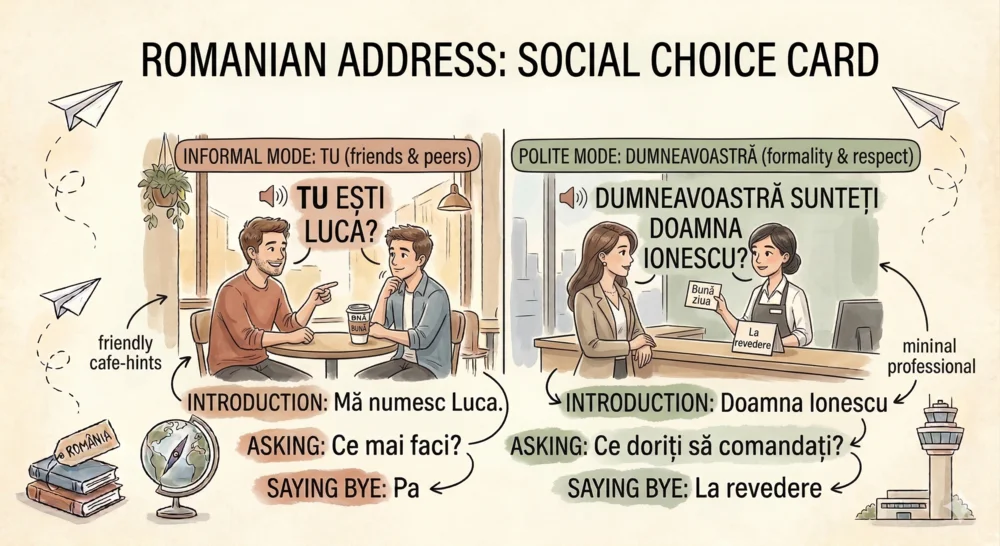
In urban Romanian, peers often move to tu fairly quickly in friendly settings. But service interactions, formal contexts, and a noticeable age gap usually keep dumneavoastră in place longer.
Notice: both speakers use tu — this is a friendly peer setting. Maya says Încântată (feminine), Andrei says Încântat (masculine).
Listen once as a full exchange, then repeat line by line. Notice how the polite part sounds slightly calmer and more formal.
The cards below reuse separate normal/slow audio files, so they also work as a pronunciation drill.
Sort the formulas into two modes: informal and polite.
Match each situation with the most natural Romanian line.
For each situation, choose: tu or dumneavoastră.
Repair the line: the register is too familiar for the situation.
Salut! Tu ești domnul Popescu?
Fill in the missing word or form.
Read the situation and choose the most natural phrase.
You are at a language exchange, facing someone your age. How do you greet them?
You enter a clinic and address the receptionist. How do you introduce yourself?
A new acquaintance asks your name. How do you answer?
How do you ask a teacher’s name when using the polite form?
You are saying goodbye to a friend after coffee. What do you say?
Put the words in the correct order to form a phrase.
Поздоровайся и представься (неформально)
Спроси имя собеседника (неформально)
Представься формально
Спроси имя вежливо
Попрощайся вежливо
Sort the phrases into two groups: greetings and farewells.
Build a short first-meeting exchange in 4-5 lines. You can make it informal or polite.
1.Say hello.
2.Introduce yourself.
3.Ask for the other person’s name in the right register.
4.Say Încântat(ă).
5.Close the exchange politely.
Practice saying this out loud.