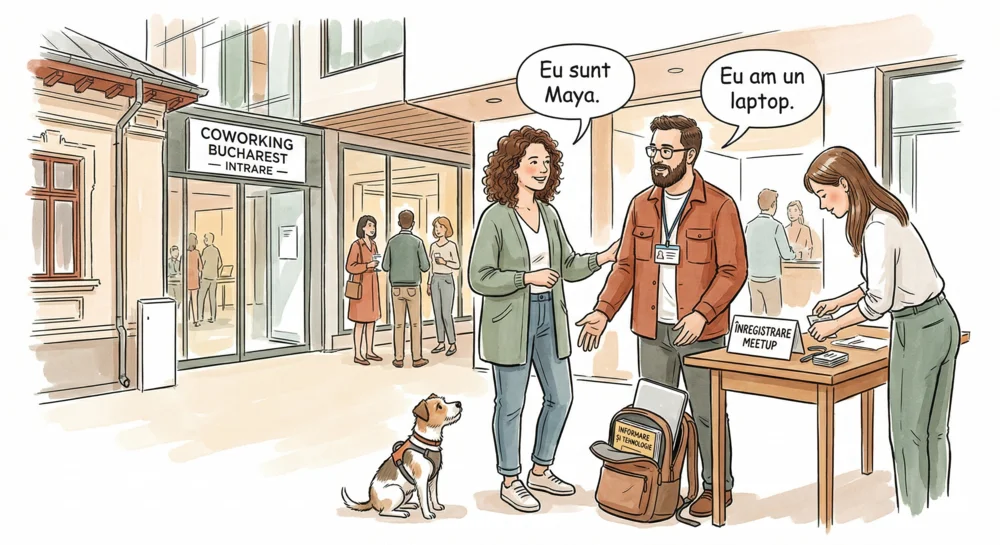
At the entrance to a meetup, you get a name badge and have to say a few words about yourself. Someone mentions they have a dog, Maya has a laptop and a book in her backpack, and Luca keeps switching between eu sunt and eu am. In this unit, you take the two most frequent Romanian verbs and use them in real mini-scenes immediately.
By the end of this unit you can
say who you are and who someone else is
say what you or someone else has
recognize `a fi` and `a avea` forms in short exchanges
build a mini profile in 2-4 lines
Two verbs that carry half of A1
`a fi` and `a avea` should become instantly recognizable. Do not memorize them as an abstract chart only; store them as chunks like `eu sunt`, `tu ești`, `eu am`, `el are`.
Person
`a fi`
`a avea`
eu
sunt
am
tu
ești
ai
el / ea
este / e
are
noi
suntem
avem
voi
sunteți
aveți
ei / ele
sunt
au
Grammar Hack
`este` / `e`
Both mean 'is'. In everyday Romanian, the short `e` is extremely common.
`eu sunt`
Use it for identity and simple self-description: `Eu sunt Maya.`
`eu am`
This is the direct 'I have' pattern, not an English-style workaround.
Learn chunks
Store `tu ești?`, `ai un...?`, and `are o...?` as ready-made micro-lines.
Positive first
At this stage, it matters more to build clean positive lines confidently.
Where these forms are needed right away
`a fi` = identity and description
Use it to say who someone is, who you are, or what role a person has.
Eu sunt Maya.
Tu ești Luca?
El este student.
`a avea` = things, pets, possession
Use it for what you have in your bag, at home, or around you.
Eu am un laptop.
Ea are un câine.
Avem cafea și apă.
Unit vocabulary
student
profesor
prieten
câine
carte
laptop
rucsac
cafea
apă
nume
Ready-made phrases
Eu sunt student.
Tu ești Luca?
El e profesor.
Eu am un laptop.
Ea are un câine.
Avem cafea.
Nice to Know: the short `e` in real speech
Instead of `este`, you will very often hear just `e`: `El e student`, `Ea e aici`. This matters early because otherwise real speech sounds faster and stranger than the textbook.
Mini dialogue: meeting at an event
Luca
Bună! Tu ești Maya?
Maya
Da, eu sunt Maya. Tu ești Luca?
Luca
Da! Eu am un laptop și o carte.
Maya
Super! Eu am o carte și un câine. El e student?
Luca
Da, el e student. Eu am un câine acasă.
Maya
Ce drăguț! Avem cafea acolo?
Notice how Luca and Maya use simple phrases with `a fi` and `a avea` in real conversation. Try to understand each line before checking the translation.
Practice in this unit
●Chunk Match
●Profile Fill
●Backpack Check
●Fast Conjugation
●Who Is It?
●Mini Profile
●Active or Passive?
●Verb Fill
●Dialogue Choice
Shadowing: profile + backpack inventory
Listen in chunks: first the `a fi` lines, then the `a avea` lines. Repeat until the forms feel like ready-made pieces rather than isolated words.
Eu sunt Maya. Tu ești Luca? Da, eu sunt Luca. Eu am un laptop și o carte. Ea are un câine. Noi avem cafea și apă.
Flashcards and pronunciation
This unit especially benefits from short chunks such as `eu sunt`, `eu am`, and `el are`, not just isolated vocabulary. Use them as ready-made speech blocks.