Văd cartea.
I see the book
The Accusative and the Direct Object
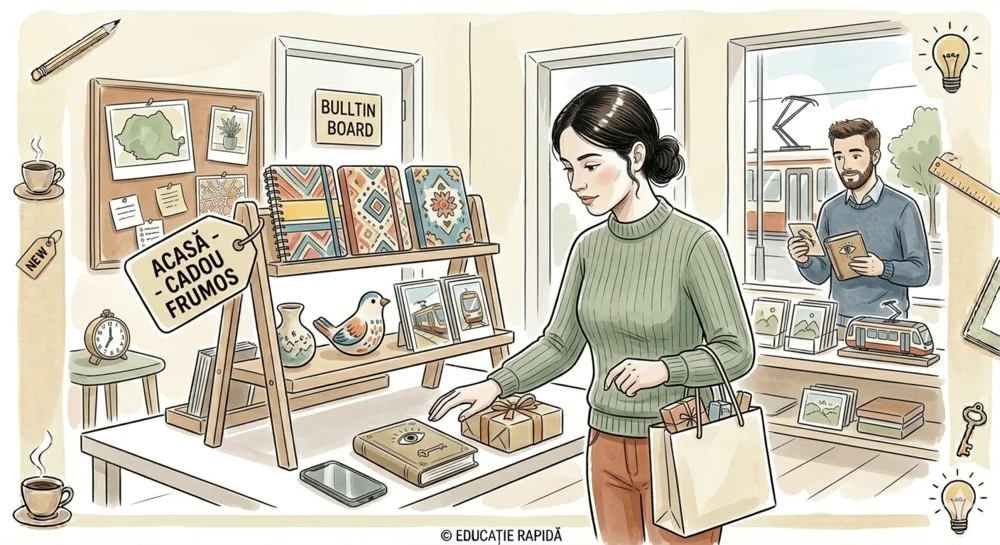
The Vibe
You are in a small shop, looking for a gift, spotting someone you know, and trying to say who you are waiting for, who you are looking for, and what you are buying. In `A2_U01`, Romanian starts marking the direct object more clearly: `văd cartea`, `cumpăr un cadou`, `îl caut pe Luca`. It is the first step toward more targeted speech after the broader but softer A1 stage.
At the start of A2, one simple idea is enough: the action lands on something. If it is a thing, you usually go without `pe`; if it is a person, `pe` becomes the important signal to notice.
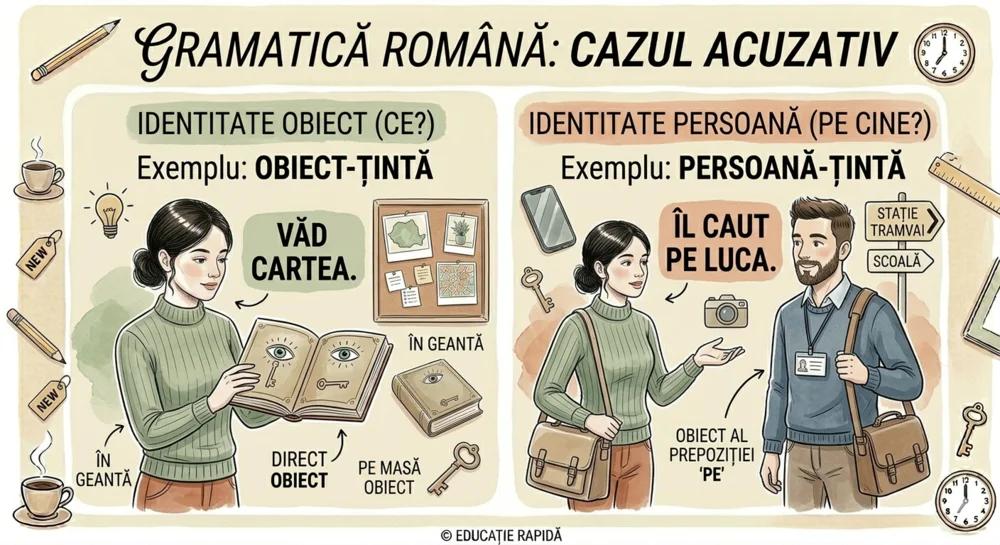
| Function | Romanian | Example |
|---|---|---|
| action targets a thing | object without `pe` | Văd cartea. |
| action targets a person | `pe` + person | Îl caut pe Luca. |
| buying / choosing an item | verb + object | Cumpăr un cadou. |
| waiting for a person | a aștepta + person | O aștept pe Maya. |
| looking for a thing | a căuta + object | Caut telefonul. |
If you have `văd`, `cumpăr`, `caut`, or `aștept`, the next question is usually: what exactly? or whom exactly?
`Văd cartea`, `cumpăr un cadou`, `caut telefonul` — with objects, the pattern is quite transparent.
In early A2 lines, this is the main signal to notice: `îl caut pe Luca`, `o aștept pe Maya`.
It is better to learn this as the target of the action than as a long declension topic.
Useful starters here are `a vedea`, `a căuta`, `a aștepta`, `a cunoaște`, and `a cumpăra`.
Shopping is perfect for showing the direct object: what exactly you take, see, or look for.
Once the target of the action is a person, `pe` becomes the key anchor in the course.

For both Russian- and English-speaking learners, `pe` can feel odd or unnecessary. But in real Romanian it is a very noticeable marker when the action targets a person. It is better to catch it early as a rhythm signal in speech rather than memorize it as a dry rule.
Listen and repeat, noticing where the target is a thing and where it is a person. On the second pass, exaggerate the rhythm of `pe Luca / pe Maya`.
The deck is built around the most useful target chunks: `văd`, `caut`, `cumpăr`, `pe Luca`, `pe Maya`.
Sort the targets by type: thing or person as the target of the action.
Match the situation with the correct Romanian target phrase.
Read the cue and give the short Romanian line.
Fix the lines: in some places `pe` is extra, and in others it is missing.
Caut pe telefonul. Îl caut Luca. O aștept Maya.
Fill the gaps so the target phrase sounds natural.
Select the sentence where `pe` is used correctly. `pe` is used only before people.
Which sentence uses 'pe' correctly?
Select the correct line:
Which is right for 'I see him'?
Complete: 'I am looking for the key.' Choose the correct form:
People need `pe`, things don't. Sort the objects into two groups.
Fill the gaps: things, people, pronouns, and the `pe` preposition.
Build a short scene in 3 direct-object phrases.
1.Say what you see.
2.Say what you are buying.
3.Say whom you are looking for or waiting for.
Practice saying this out loud.