Te văd.
I see you
Personal Pronouns in the Accusative
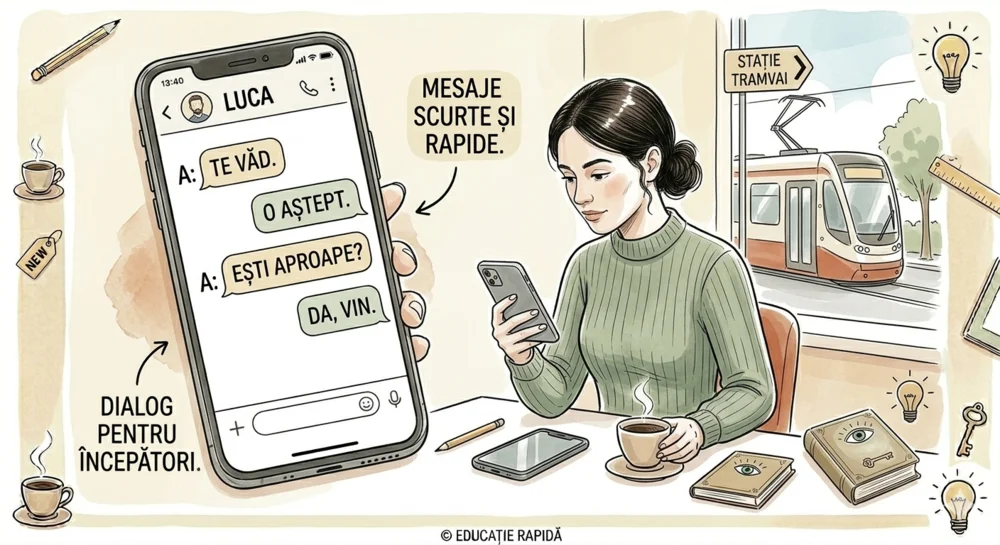
The Vibe
Now the target of the action does not need to be repeated as a full noun every time. You text, call, wait for someone, know someone, and the language gets shorter: `te văd`, `mă așteaptă`, `îl cunosc`, `o caut`. In `A2_U02`, Romanian starts sounding much more alive and natural.
At this stage, you do not need every form. A compact high-frequency set is enough to make your Romanian sound much more natural in chats and short dialogues.

| Whom/what? | Short form | Example |
|---|---|---|
| me | mă | Mă vezi? |
| you | te | Te cunosc. |
| him | îl | Îl caut. |
| her | o | O aștept. |
| us / you | ne / vă | Ne așteaptă. / Vă văd. |
Look at pairs like `Îl caut pe Luca` -> `Îl caut` and `O aștept pe Maya` -> `O aștept`.
This is one of the main rhythms of the unit: `te văd`, `mă cunoști`, `îl caut`, `o aștept`.
It is better to remember `te văd` and `mă aștepți` than to memorize a bare chart with no movement.
`mă`, `te`, `îl`, and `o` cover a huge part of simple interaction.
This is not just grammar. It is a step toward shorter, quicker, more natural lines.
Accusative pronouns enter short messages very naturally because they let you avoid repeating names and objects.
This is the perfect scene for the topic: the target is already understood from context, so the line wants to become shorter.

At first, these short forms can feel tiny and almost invisible in real speech. That is normal. They often pass very quickly, which is why they need to be trained as chunks, not only read from a chart.
Listen and repeat, keeping the rhythm `pronoun + verb`. On the second pass, try to identify each form by ear without visual support.
The deck is built around the most useful pronoun chunks that immediately transfer into chat and short dialogue.
Sort the forms by number.
Match the full phrase with its shorter pronoun version.
Give the short Romanian phrase with the pronoun.
Fix the word order: the short form is in the wrong place.
Văd te. Caut îl. Aștept o.
Insert the correct short form.
Select the phrase with the correct short accusative pronoun.
Choose the correct pronoun: 'I see you'
Select the right pronoun: 'Do you know him?'
Which is correct for 'Do you see us?'
Complete: 'They are looking for her.' Choose the pronoun:
Fix the lines: remove unnecessary repeats and prepositions from short forms.
Te caut pentru tine. Mă vede pe mine. Ne caut pentru noi. Îl aștept pentru el.
Sort accusative pronouns by number and gender.
Build a mini chat in 3 pronoun lines.
1.Say one line with `te`.
2.One with `mă`.
3.One with `îl` or `o`.
Practice saying this out loud.