Am fost acasă.
I was at home
Past Tense: Perfectul compus
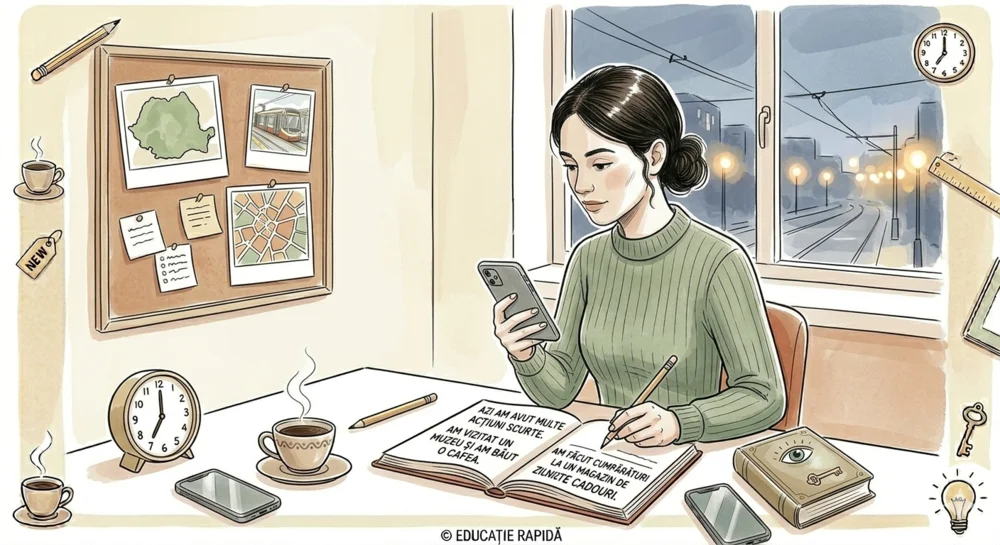
The Vibe
You reply to a message in the evening, think back over your day, and say where you were, what you bought, whom you met, and what you watched. In `A2_U03`, the first truly useful past tense arrives: `am fost`, `am cumpărat`, `am văzut`. This is the moment when Romanian starts supporting simple everyday storytelling.
At the start, you do not need a heavy typology of participles. It is more useful to see the working formula and tie it straight to real yesterday-actions.

| Person | Form | Example |
|---|---|---|
| я | am + participiu | Am cumpărat cafea. |
| ты | ai + participiu | Ai văzut filmul? |
| он/она | a + participiu | A fost acasă. |
| мы | am + participiu | Am mers în centru. |
| вы | ați + participiu | Ați ajuns târziu. |
Technically the pattern runs through `a avea + participle`, but in the course it works better as a past-result chunk.
`am fost`, `am mers`, `am văzut`, `am cumpărat`, `am vorbit` quickly unlock usable past tense.
This topic works especially well with `ieri`, `azi-dimineață`, `aseară`, and `după curs`.
Past tense enters better through a diary, chat recap, and tiny story than through isolated forms.
At A2, a short accurate past line matters more than ambitious storytelling.
Past tense appears naturally when you simply recap your day or answer `Ce ai făcut?`.
The topic becomes interactive immediately through short questions and answers.

As soon as the learner gains control of `Perfectul compus`, their Romanian starts feeling much more adult. This tense is very frequent in real speech and gives a fast boost in communicative confidence.
Listen and repeat, stressing the completed-action rhythm. On the second pass, replace one or two actions with your own.
The deck is built around high-frequency past chunks useful for diary, chat recap, and mini-storytelling.
Sort the items by type: past chunk or time marker.
Match the situation with the past-tense line.
Insert the correct auxiliary.
Read the cue and give the short past-tense line.
Fix the mistakes in the yesterday recap.
Ieri sunt în centru. Am vedea filmul. Ai fost acasă? Da, am fost.
Select the correct irregular past participle form.
Choose the correct past form: 'I went'
What is the correct participle for 'to see'?
Select the correct past form: 'I wrote'
What is right for 'they read'?
Fill in the auxiliary verb for all persons: am/ai/a/am/ati/au.
Fix the lines: use correct participles and auxiliaries in the day-recap story.
Ieri am mers la parc. Eu vin o carte interesanta. Am intalnitul pe Luca si am vorbit cu el. Noi merge mai departe si ajungem acasa tarziu.
Build a short day recap in 3 past lines.
1.Say where you were.
2.Say what you bought or saw.
3.Say whom you spoke with.
Practice saying this out loud.