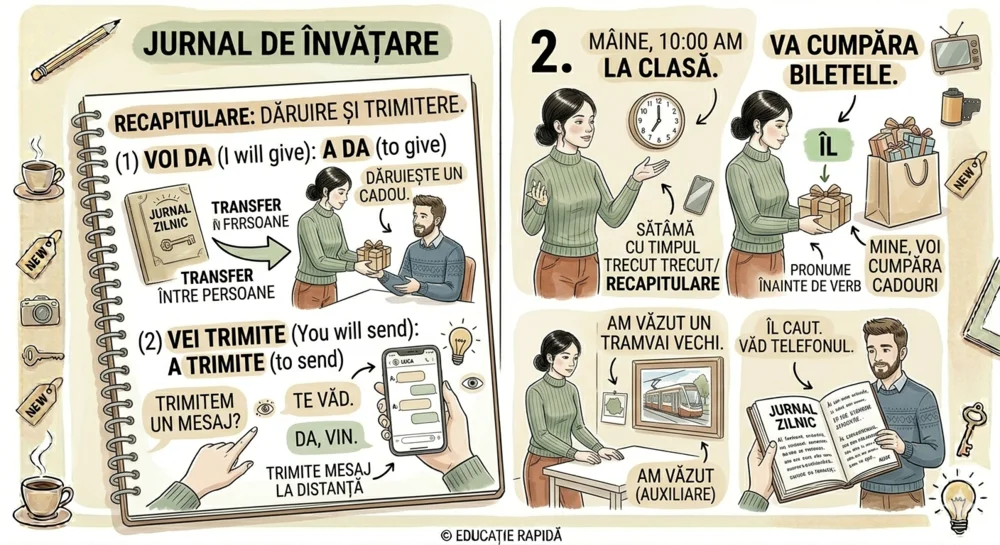
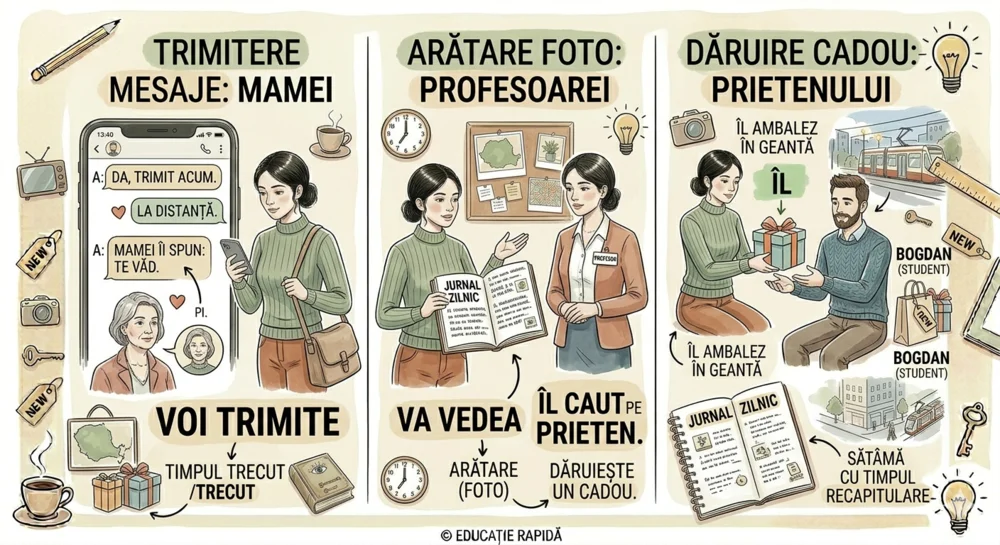
You write to a friend, give a notebook to a teacher, send a message to your mother, and show a photo to a colleague. `A2_U07` introduces the dative not as a dry case, but as transfer language: who you give, write, show, or send something to.
By the end of this unit you can
answer the question `to whom?` in simple everyday lines
talk about giving an object, a message, or information
Dative case map
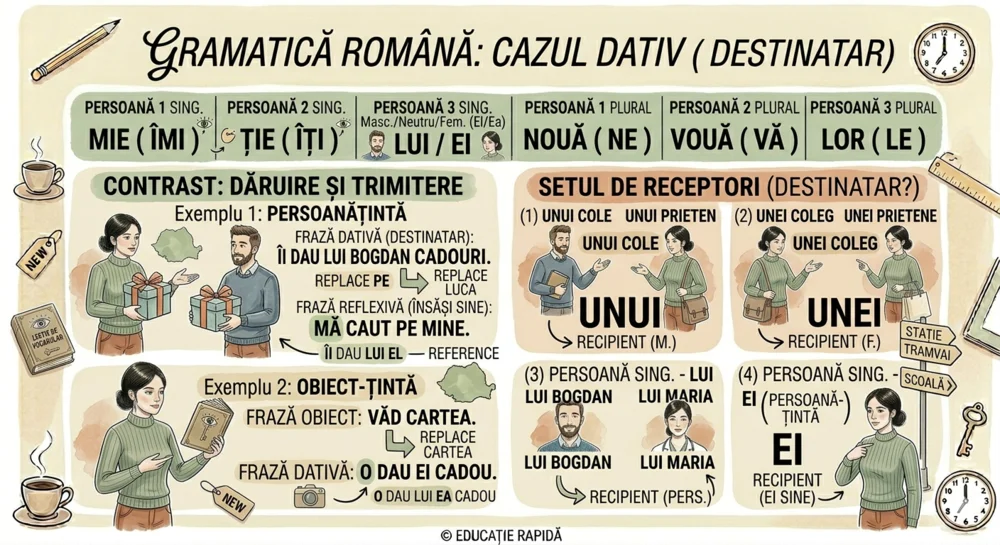
The key is to feel the action moving toward a person. Not just `a message`, but `a message to your mother`; not just `a gift`, but `a gift to a friend`.
Type
Form
Example
муж. с `un`
unui
Scriu unui coleg.
жен. с `o`
unei
Dau un cadou unei prietene.
опред. муж.
-lui
Arăt poza profesorului.
опред. жен.
-ei
Trimit un mesaj mamei.
Grammar Hack
Think direction, not case labels
If the action moves toward a person, the dative is often the right tool: give, show, send, explain.
`unui / unei` work best as pairs
Memorize them as ready-made chunks: `unui coleg`, `unei prietene`.
A gift, a photo, a letter, a message, a book, an explanation: all of these make the dative come alive.
Start from the verb
Begin with `dau / scriu / arăt / trimit`, then add the recipient.
Where the topic comes alive right away
messages and writing
The dative works very naturally through texting, e-mail, and short everyday actions.
Scriu unui coleg.
Trimit un mesaj mamei.
Spun adevărul Mariei.
objects and information
The topic becomes easy to feel when you pass something physical or informational to someone.
Dau un cadou unei prietene.
Arăt poza profesorului.
Explic regula copilului.
Verbs and recipients
a da
a scrie
a arăta
a trimite
a spune
unui coleg
unei prietene
profesorului
mamei
Mariei
Ready-made phrases
Dau un cadou unei prietene.
Scriu unui coleg.
Arăt poza profesorului.
Trimit un mesaj mamei.
Spun adevărul Mariei.
Nice to Know
The dative is easiest to absorb not through an abstract table, but through social gestures: who you give, write, send, or explain something to. That makes the topic usable in real speech very quickly.
The Real Deal
●matching: what goes to whom
●sorting: `unui / unei / -lui / -ei`
●fill-in: the correct recipient form
●a mini dialogue about a message, a gift, or a photo
Shadowing & Audio
Here it is important to hear the dative as a whole chunk: not just `unei`, but `unei prietene`; not just `-lui`, but `profesorului`.
Flashcards
The flashcards are built around ready-made recipient chunks and very frequent dative phrases.
Checkpoint
✓I can say who I give or send something to.
✓I can use `unui / unei / -lui / -ei` in simple lines.
✓I can describe a short everyday scene with a recipient.
Flashcards
1 / 20
Dau un cadou unei prietene.
I give a gift to a friend
Scriu unui coleg.
I write to a colleague
Arăt poza profesorului.
I show the photo to the teacher
Trimit un mesaj mamei.
I send a message to my mother
Spun adevărul Mariei.
I tell the truth to Maria
unui coleg
to a colleague
unei prietene
to a female friend
profesorului
to the teacher
mamei
to mother / to my mother
Mariei
to Maria
tatălui
to the father
fratelui
to the brother
surorii
to the sister
vecinului
to the neighbor
a oferi
to offer
Oferi unui prieten o invitație.
I offer a friend an invitation
unui prieten
to a friend
Arăt unei fete fotografia.
I show a girl the photo
unei fete
to a girl
a arăta
to show
Exercises
Which dative form is it?
Sort the recipient chunks by form type.
unui coleg
unei prietene
profesorului
mamei
unui copil
Dative Match
Match the situation with the correct dative phrase.
I give a gift to a friend
I write to a colleague
I show the photo to the teacher
I send a message to my mother
Dative Fill
Insert the correct dative form.
Scriu ___ coleg.
Dau un cadou ___ prietene.
Arăt poza profesor___.
Trimit un mesaj mam___.
Spun adevărul Mari___.
Dative Response
Read the cue and give a short line with the recipient.
I show the rule to the child
I tell the truth to Maria
I send an email to the teacher
Dative Repair
Fix the lines: the recipient form is missing.
Dau un cadou prietenă. Scriu coleg. Trimit un mesaj mama.
Pick the Dative
Choose the correct dative form for the recipient.
Dau un cadou ___ prietene.
Scriu ___ coleg.
Arăt poza ___.
Trimit un mesaj ___.
Spun adevărul ___ copil.
Sort by Gender
Classify dative nouns by gender.
profesorului
colegului
copilului
mamei
prietenei
femeii
Repair Recipients
Fix the sentences: restore correct dative forms.
Dau un cadou prietena. Scriu coleg și spun adevărul profesore. Trimit un mesaj mama și femeie din bloc.
Mini Recipient Talk
Build a short talk with the dative.
1.Say who you are writing to today.
2.Say who you want to show a photo to.
3.Say who you will send a message to.
Astăzi scriu unui coleg. Arăt poza profesorului. Trimit un mesaj mamei.