Îmi place cafeaua aceasta.
I like this coffee
Dative Personal Pronouns in Everyday Speech
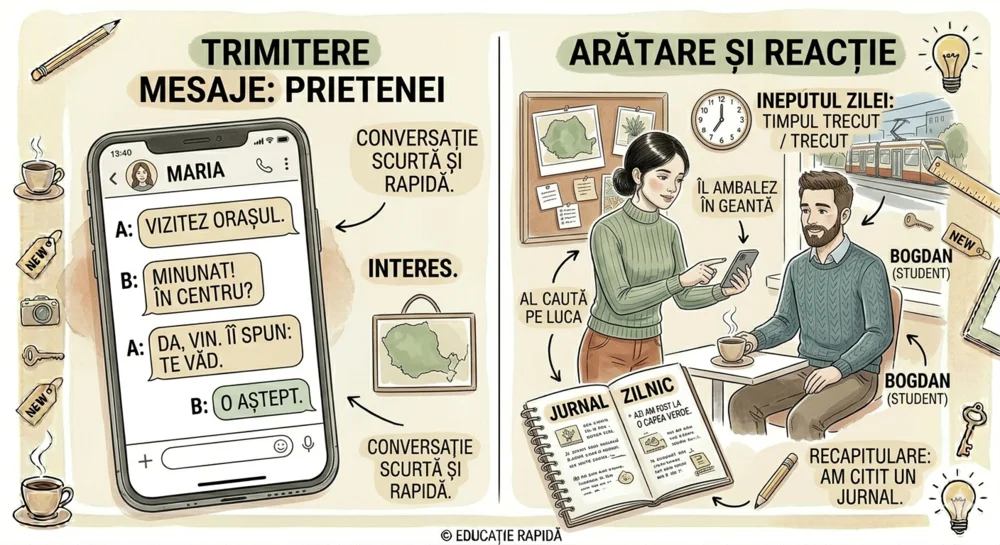
The Vibe
You no longer repeat the full recipient phrase every time. Instead of `scriu mamei`, you get `îi scriu`; instead of `dau colegului`, you get `îi dau`. `A2_U08` makes the language more compact, more alive, and much closer to real dialogue.
These are short, very frequent speech chunks. It is better to hear and remember them as ready-made particles inside the phrase.

| To whom | Form | Example |
|---|---|---|
| мне | îmi | Îmi place cafeaua. |
| тебе | îți | Îți scriu diseară. |
| ему / ей | îi | Îi spun adevărul. |
| нам | ne | Ne arată fotografia. |
| вам | vă | Vă dau adresa. |
| им | le | Le explic regula. |
Instead of the full `profesorului` or `mamei`, spoken Romanian often switches to the short `îi`.
Not isolated `îți`, but `îți scriu`; not isolated `le`, but `le explic`.
This pattern is so frequent that it should feel almost like a separate formula.
Dative pronouns work best through messages, explanations, answers, and reactions.
What matters is hearing the order and flow: `îți scriu`, `îi spun`, `vă dau`, `le explic`.
Short dative forms sound most natural in dialogue.
Some patterns become almost ready-made formulas.

As soon as the learner starts using `îmi / îți / îi` with confidence, their Romanian sounds much less textbook-like. This is one of the units that noticeably shortens the distance to real speech.
In this unit the rhythm of the short forms matters a lot. Listen not to isolated pronouns, but to full chunks: `îți scriu`, `îi spun`, `vă dau`, `le explic`.
The flashcards are built around the most frequent dative chunks and short dialogue lines.
Sort the dative pronouns by number.
Match the situation with the correct line using a dative pronoun.
Insert the correct dative form.
Read the cue and give a short reaction with a dative form.
Fix the lines: the dative form is missing.
Scriu diseară. Spun adevărul. Dau adresa. Explic regula.
Choose the correct dative pronoun for each context.
___ scriu diseară.
___ spun adevărul.
___ arată fotografia.
___ dau adresa.
___ explic regula.
Classify pronouns by case - accusative or dative.
Fix the sentences: find errors between accusative and dative.
Te dau adresa. Mă explic regula. Vă scriu diseară. Ne place muzica.
Build a short dialogue-style mini talk with dative pronouns.
1.Say who you will write to today.
2.Say who you will explain the rule to.
3.Say what you like today.
Practice saying this out loud.