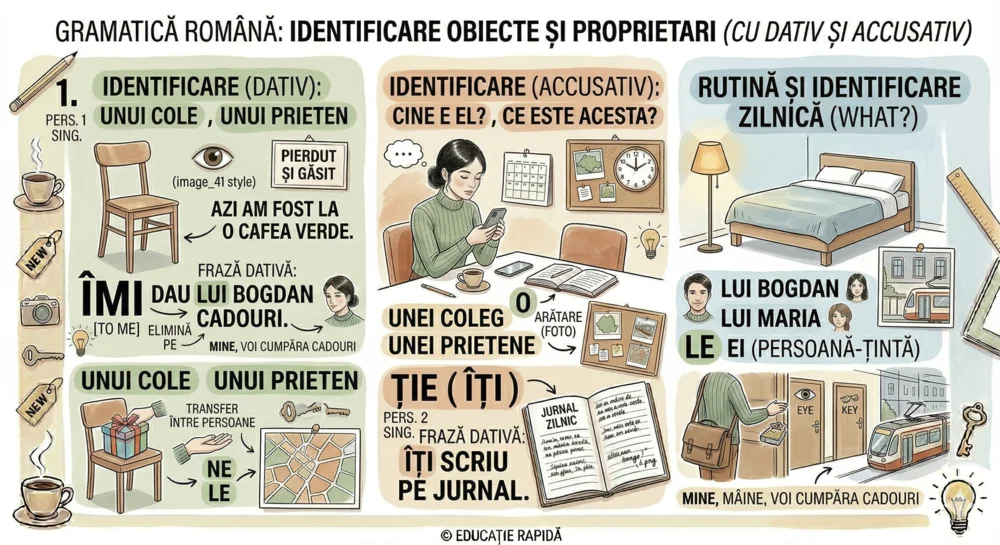
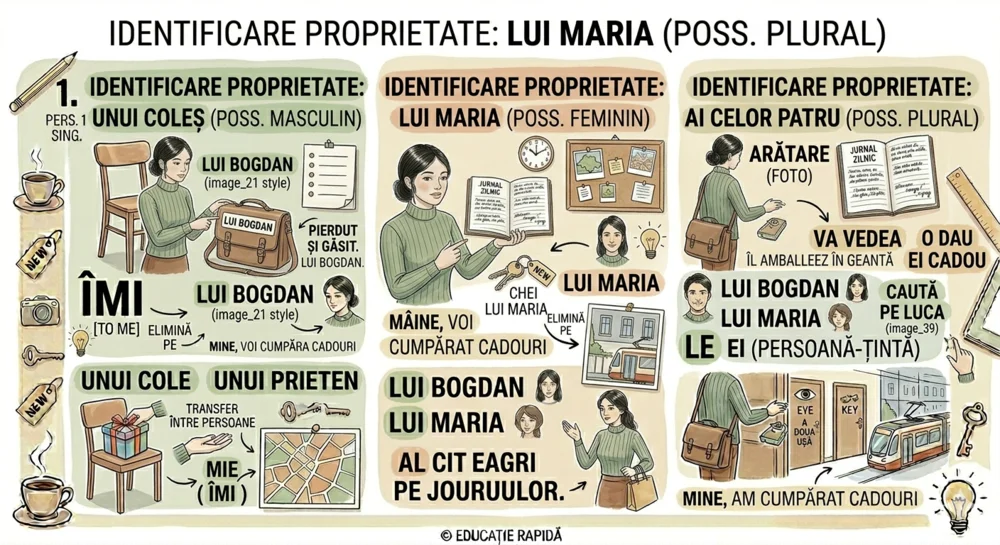
You find objects, check who they belong to, and identify ownership. `A2_U09` is the language of possession: `cartea profesorului`, `geanta Mariei`, `cheile apartamentului`, `numărul colegului`.
By the end of this unit you can
говорить, кому принадлежит предмет
использовать родительный падеж в простых фразах принадлежности
работать с `al / a / ai / ale`
спрашивать и отвечать на `Al cui este?`
Genitive and possession map
This is the language of ownership and relation. Not just an object, but an object tied to a person, place, or other thing.
What
Form
Example
книга преподавателя
profesorului
Cartea profesorului este aici.
сумка Марии
Mariei
Geanta Mariei este pe scaun.
ключи квартиры
apartamentului
Cheile apartamentului sunt pe masă.
номер коллеги
colegului
Acesta este numărul colegului.
Grammar Hack
Think through the question `whose?`
The genitive starts working when you search for an owner: whose bag, whose keys, whose number.
Learn it as ownership chunks
It is better to remember `cartea profesorului`, `cheile apartamentului` than a detached form on its own.
`al / a / ai / ale` link the thing and the owner
These small words help build the agreement pattern of possession.
The topic thrives in lost-and-found scenes
Left-behind objects, documents, keys, a bag on a chair: all of that is ideal context.
Do not overload the terminology
At this stage the ownership logic matters more than a long grammatical explanation.
Where the topic comes alive right away
objects and lost items
The most natural scene is finding an object and figuring out whose it is.
Geanta Mariei este aici.
Cheile apartamentului sunt pe masă.
Telefonul colegului este în clasă.
documents and details
Ownership language often appears with address, number, documents, and contacts.
Acesta este numărul colegului.
Aceasta este adresa profesorului.
Al cui este carnetul?
Objects and owners
cartea
geanta
cheile
telefonul
numărul
profesorului
Mariei
apartamentului
colegului
al cui
Ready-made phrases
Cartea profesorului este aici.
Geanta Mariei este pe scaun.
Cheile apartamentului sunt pe masă.
Acesta este numărul colegului.
Al cui este telefonul?
Nice to Know
The genitive becomes useful very quickly in real life because it is tied to very everyday situations: finding keys, figuring out whose number this is, asking whose bag is on the chair.
The Real Deal
●matching: вещь и владелец
●sorting: `al / a / ai / ale`
●fill-in: правильная форма принадлежности
●мини-диалог про потерянную вещь или контакт
Shadowing & Audio
Ownership language is best heard as whole chunks: `cheile apartamentului`, `cartea profesorului`, `geanta Mariei`, not as isolated forms.
Flashcards
The unit flashcards are built around ownership chunks and the question `Al cui este?`.
Checkpoint
✓I can say who an object belongs to.
✓I can ask `Al cui este?`.
✓I can use ownership chunks in an everyday scene.
Flashcards
1 / 20
Cartea profesorului este aici.
the teacher's book is here
Geanta Mariei este pe scaun.
Maria's bag is on the chair
Cheile apartamentului sunt pe masă.
the apartment keys are on the table
Acesta este numărul colegului.
this is the colleague's number
Al cui este telefonul?
whose phone is this?
cartea profesorului
the teacher's book
geanta Mariei
Maria's bag
cheile apartamentului
the apartment keys
numărul colegului
the colleague's number
al cui
whose
Biroul directorului este mare.
the director's office is large
Mașina vecinului este albă.
the neighbor's car is white
Ușa clasei este deschisă.
the classroom door is open
Hainele copilului sunt colorate.
the child's clothes are colorful
Prietenii familiei sunt interesanți.
the family's friends are interesting
biroul directorului
the director's office
mașina vecinului
the neighbor's car
ușa clasei
the classroom door
hainele copilului
the child's clothes
prietenii familiei
the family's friends
Exercises
Singular or Plural Ownership?
Sort `al / a / ai / ale` by number.
al
a
ai
ale
Ownership Match
Match the object with the correct ownership phrase.
the teacher's book is here
Maria's bag is on the chair
the apartment keys are on the table
this is the colleague's number
Genitive Fill
Insert the correct ownership form.
Cartea profesor___ este aici.
Geanta Mari___ este pe scaun.
Cheile apartament___ sunt pe masă.
Numărul coleg___ este corect.
Al ___ este telefonul?
Ownership Response
Read the cue and give a short ownership phrase.
this is the teacher's address
whose keys are these?
this is Maria's phone
Ownership Repair
Fix the lines: the ownership form is missing.
Cartea profesor este aici. Geanta Maria este pe scaun. Cheile apartament sunt pe masă.
Pick the Genitive
Choose the correct genitive ending to express possession.
Cartea profesor___ este aici.
Geanta Mari___ este pe scaun.
Cheile apartament___ sunt pe masă.
Numărul coleg___ este corect.
Telefonul prietene___ nu merge.
Sort by Gender
Classify genitive nouns by gender.
profesorului
apartamentului
colegului
Mariei
prietenei
femeii
Repair Ownership
Fix the sentences: restore correct genitive endings.
Cartea profesor este aici. Geanta Maria este pe scaun. Cheile apartament sunt pe masă. Telefonul prietenei nu merge.
Mini Ownership Talk
Build a short talk with ownership chunks.
1.Say whose book you have right now.
2.Say where the apartment keys are.
3.Say whose number you have in your phone.
Am cartea profesorului. Cheile apartamentului sunt pe masă. Am numărul colegului în telefon.