îmi fac
I make for myself
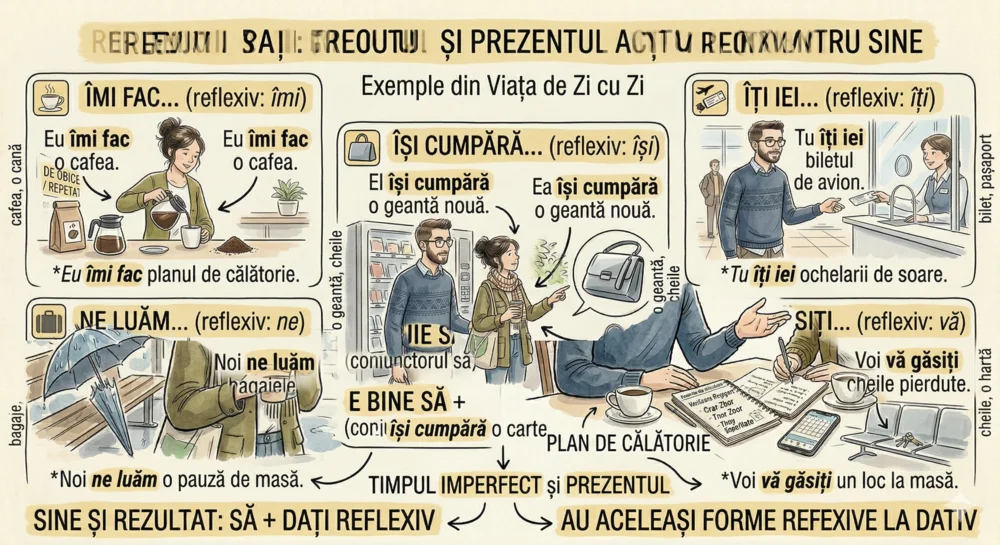
Dative reflexive verbs for actions done for oneself
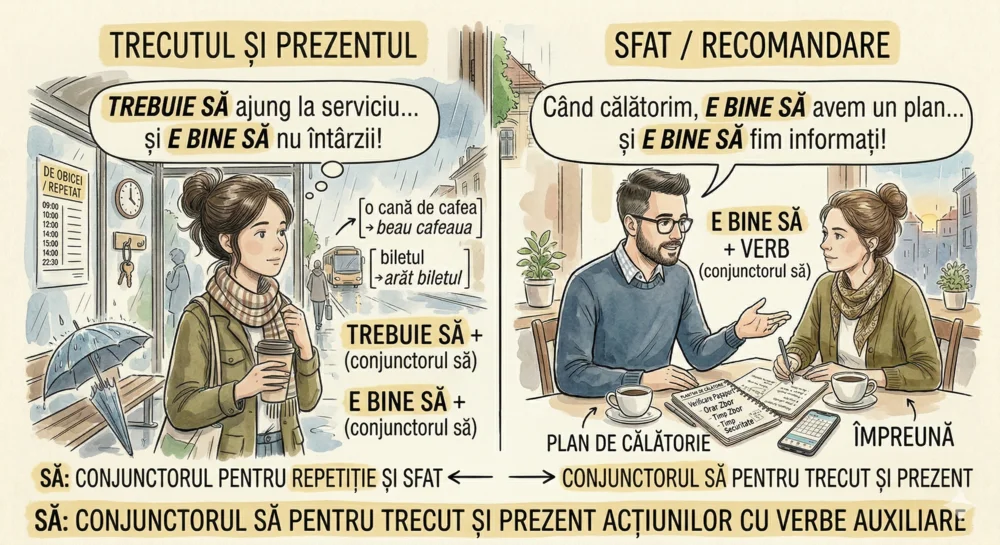
The Vibe
`B1_U03` adds a practical everyday nuance: not just an action, but an action done for oneself. This is a living part of the language around self-care, preparation, personal choices, and routine comfort.
This topic works especially well with small daily actions: making yourself coffee, buying yourself a ticket, preparing your things, finding time for yourself.
| Function | Chunk | Example |
|---|---|---|
| для себя | îmi fac | Îmi fac o cafea. |
| для тебя | îți pregătești | Îți pregătești geanta. |
| для себя | își cumpără | Își cumpără o carte. |
| для нас | ne luăm | Ne luăm bilete. |
| для вас | vă găsiți | Vă găsiți timp. |
The most useful way to hear it is as the nuance of `make yourself / buy yourself / get yourself`.
`mă spăl` = I wash myself. `îmi fac cafea` = I make myself coffee. The logic is different.
It sounds natural in prep routines, shopping, comfort talk, and personal logistics.
It is better to keep ready-made chunks: `îmi fac`, `îți iei`, `își cumpără`, `ne găsim timp`.
This is where the language becomes subtler and closer to real life rather than textbook patterning.
Here the action is directed straight at the person.
Here the nuance becomes `for oneself`, `for your own use`, `for your own benefit`.
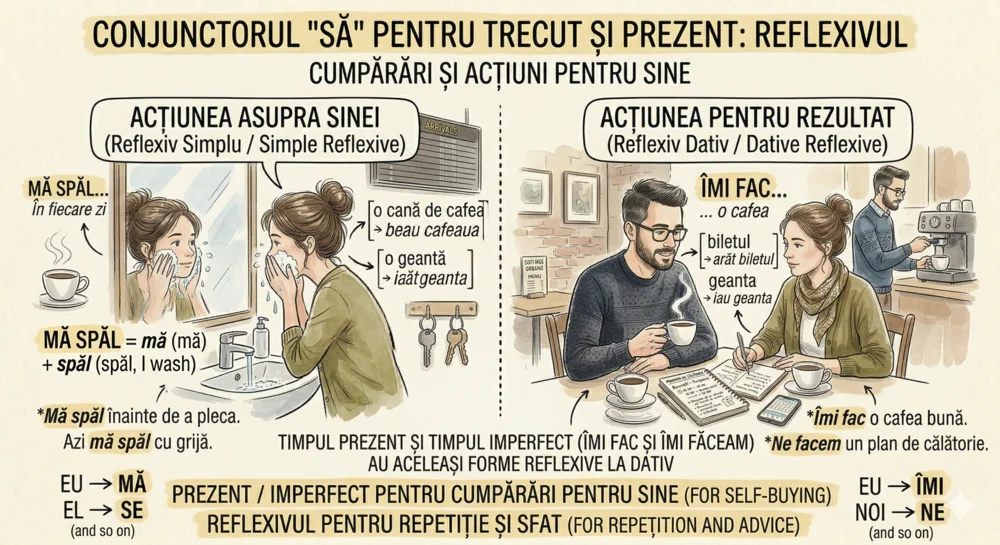
This is one of those topics that makes the language feel much less textbook-like. Through these small everyday nuances, speech starts sounding closer to real daily Romanian life.
Full tasks and answer keys live in structured `exercises.json`.
The shadowing track is longer here: it includes a full prep scene with several dative reflexive chunks. This is a deliberate density increase for `B1`.
This unit now uses `12` flashcards instead of `10`, gradually expanding active vocabulary and chunk memory at `B1` level.
Sort the lines by pattern.
Match the everyday scene with the natural dative reflexive chunk.
Insert the suitable short form.
Choose the natural everyday chunk.
Fix the broken prep scene.
Mă fac o cafea și te pregătești geanta. După aceea ne luăm timp pentru o pauză.
Read the sentence and pick the right dative reflexive form.
Dimineață ___ fac o cafea și ___ pregătesc geanta.
Tu ___ iei umbrela și ___ găsești chei?
El ___ cumpără ceva la piață și ___ pregătește masa.
Noi ___ luăm timp și ___ odihnim un pic.
Voi ___ causați problemă și ___ învinovățiți pe ceilalți.
Classify the phrases into three categories by reflexive type.
Find and fix errors in simple and dative reflexive forms.
Dimineață mă fac o cafea și te pregătești geanta. Mă iau umbrela și ne odihnim puțin. Apoi se cumpără ceva de mâncare. Tu te iei un bilet și se găsești cheile. Noi mă luăm timp și vă odihniți. El se cumpără ceva la magazin și vă pregătesc masa. Eu mă fac o cană de ceai și mă pregătesc pentru ziua de mâine. Prietena mea se iau o pernă și se odihnesc. La final noi mă luăm o pauză mică.
Build a short scene with dative reflexive verbs.
1.Say what you do for yourself before leaving.
2.Add what you get or prepare for yourself.
3.Say what another person buys or finds for themselves.
4.Build 4-5 lines into one everyday scene.
Practice saying this out loud.