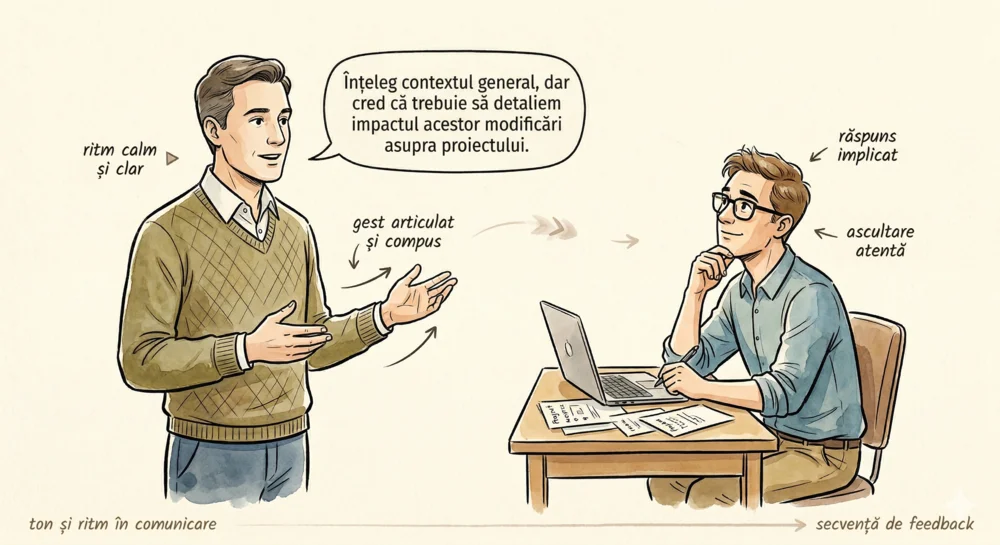
Speak more clearly, do not answer so quickly, I have almost finished, let us meet there later
`B1_U09` makes speech livelier and more precise. Adverbs shape tempo, tone, degree, and location, so they often turn a flat sentence into something natural and expressive.
By the end of this unit you can
clarify where, when, how, and to what degree an action happens
make your speech less flat and more expressive
use adverbs to evaluate speed, clarity, intensity, and frequency
build more natural spoken scenes through an adverb layer
Where the topic becomes useful immediately
Adverbs are needed in any live scene: to explain pace, precision, urgency, degree, frequency, or place. Without them, speech stays too plain and thin.
Function
Form
Example
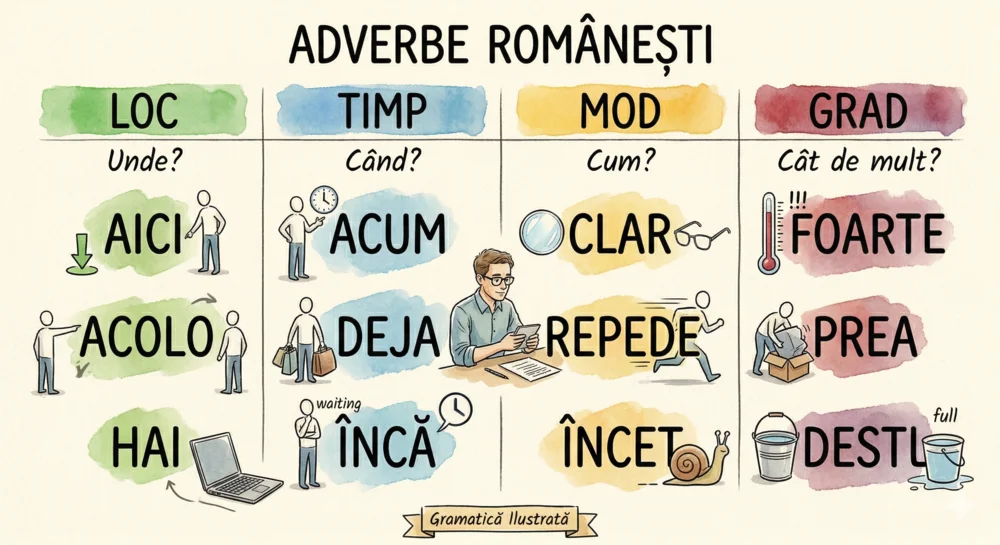
место
aici / acolo
Ne vedem acolo mai târziu.
время
acum / deja / încă
Încă nu e gata, dar deja lucrăm.
образ действия
clar / repede / încet
Vorbește clar, nu atât de repede.
степень
foarte / prea / destul
E foarte util, dar puțin prea lung.
частота
mereu / uneori
Uneori răspunde prea repede.
Grammar Hack
An adverb is a meaning-adjuster
It does not just decorate; it changes how the action is perceived: `speaks` vs `speaks clearly` vs `speaks too fast`.
Think in contrasts
The topic settles more easily through pairs: `aici / acolo`, `acum / deja / încă`, `repede / încet`, `foarte / prea / destul`.
This is the language of tone and evaluation
At this level, adverbs help not only describe, but evaluate: too fast, clear enough, almost ready.
Useful for feedback talk
Adverbs especially often live in advice, reaction, clarification, explanation, and peer feedback.
A strong expressive jump
They make speech noticeably richer without requiring a drastic grammar jump.
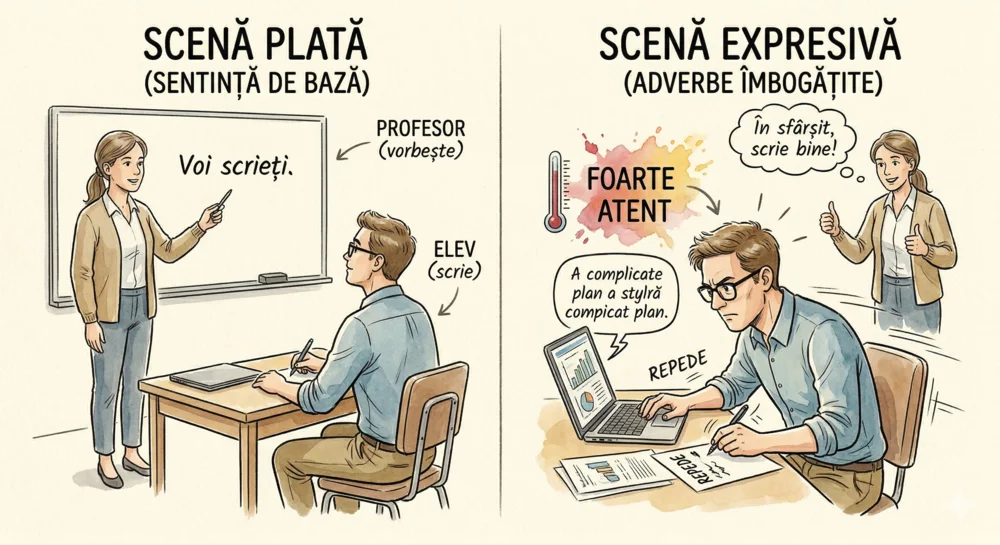
How adverbs change the scene
flat sentence
Without the adverb layer, the information stays too general.
Vorbește.
Ajunge.
Lucrează.
alive and precise sentence
With adverbs, rhythm, evaluation, and specificity appear.
Vorbește clar și destul de calm.
Ajunge acolo imediat.
Lucrează foarte bine sub presiune.
Core adverbs
aici
acolo
acum
deja
încă
mereu
uneori
bine
clar
repede
încet
foarte
prea
destul
Ready-made phrases
Vorbește clar și mai încet.
Ajung acolo imediat.
Încă nu e gata, dar aproape am terminat.
Uneori răspunde prea repede.
Lucrează foarte bine sub presiune.
Nice to Know
This is one of the units where speech starts sounding noticeably more human. These small layers are what make a sentence feel alive, evaluative, and more natural for real communication.
The Real Deal
●sorting: place / time / manner / degree
●matching: сцена и выбор наречия
●fill-in: expressive precision
●correction: flat lines become more natural
●speaking: a short feedback or reaction scene with adverbs
Full tasks and answer keys live in structured `exercises.json`.
Shadowing & Audio
The shadowing keeps the same density, but what matters here is hearing how adverbs change intonation, pace, and degree rather than simply adding extra words.
Flashcards
The flashcards stay dense, but it matters especially here to hold the contrast pairs and their effect on sentence meaning.
Checkpoint
✓I can say more precisely where, when, how, and to what degree something happens
✓I feel the difference between `very`, `too`, `enough`, `still`, and `already`
✓I can make speech less flat and more alive
Flashcards
1 / 20
aici
here
acolo
there
acum
now
deja
already
încă
still / yet
mereu
always
uneori
sometimes
bine
well
clar
clearly
repede
quickly
încet
slowly
foarte
very
prea
too
destul
quite / enough
repede
quickly
prea repede
too fast
mai clar
more clearly
nu am înțeles
I didn't understand
poți repeta
can you repeat
am aproape terminat
I'm almost done
Exercises
Category Sort
Sort the adverbs by their main function.
aici
deja
clar
repede
foarte
prea
Scene Match
Match the scene with the natural adverb layer.
ask someone to speak more clearly and slowly
say that you will be there right away
say that it is still not ready
say that the person answers too quickly
Adverb Fill
Insert the adverb that makes the sentence more precise.
Vorbește mai ___, te rog.
Ajung ___, nu-ți face griji.
E ___ bun, dar nu perfect.
Răspunde ___ repede și nu e clar.
___ nu am terminat, dar e aproape gata.
Contrast Choice
Choose the adverb that better carries the meaning.
say that you already finished: încă / deja
say that you are still waiting: deja / încă
say that something is too expensive: foarte / prea
Flat Repair
Make the lines less flat and more natural.
Vorbește. Ajung. Nu e gata. Lucrează bine.
Choose the Right Adverb
Select the adverb that better expresses the meaning of the sentence.
Ajung ___ decât gândesc, nu-ți face griji.
Răspunde prea ___ și nu e clar ce spune.
Lucrul acesta este ___ bun, dar depinde de context.
Nu am ___ terminat, dar sunt ___ aproape gata.
Vorbește mai ___, te rog, vorbești prea ___.
Sort by Adverb Type
Sort the adverbs by their function: time/position, manner, or degree.
acolo
imediat
deja
încă
clar
repede
ușor
prea
foarte
destul
Feedback Scene
Build a short expressive scene with adverbs.
1.Say how the person speaks or works.
2.Add where or when something happens.
3.Say whether it is too fast, very good, or still not ready.
4.Build a short feedback scene with several adverbs.
Vorbește destul de clar, dar uneori prea repede. Ajunge acolo imediat și lucrează foarte bine sub presiune. Încă nu e gata, dar aproape a terminat.