rădăcină
word root
Word formation: suffixes, prefixes, and compounds
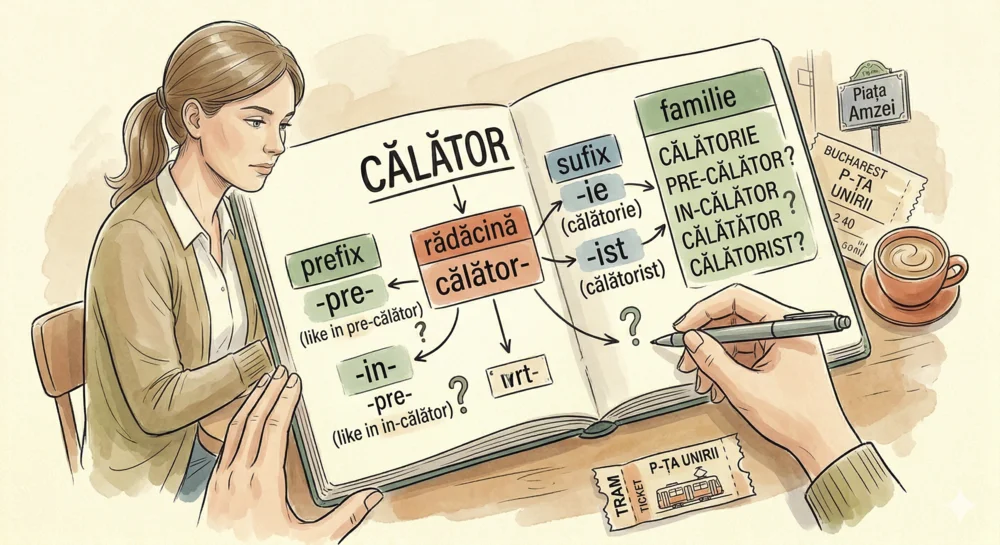
The Vibe
`B1_U12` teaches you not to memorize every new word separately, but to read it like a construction: root, prefix, suffix, meaning shift. This is especially useful for real reading.
Look first at the familiar part, then at the prefix or suffix. Even if the exact translation is unknown, you can often understand the direction of meaning.

| Root | Word | What changed | Example |
|---|---|---|---|
| lucr- | lucrător | person who does the action | Lucrătorul vine dimineața. |
| clar | neclar | negative meaning | Răspunsul este neclar. |
| face | reface | again | Trebuie să refac exercițiul. |
| bun | bunătate | abstract quality | Apreciez bunătatea ei. |
| român | românește | manner / language | Vorbesc românește. |
| frumos | înfrumuseța | make become | Vor să înfrumusețeze strada. |
`clar` -> `neclar`, `plăcut` -> `neplăcut`, `interesant` -> `neinteresant`. This is one of the most useful reading patterns.
`a citi` -> `a reciti`, `a face` -> `a reface`. If an action repeats, look for `re-`.
`a citi` -> `cititor`, `a lucra` -> `lucrător`, `a vinde` -> `vânzătoare`.
`bun` -> `bunătate`, `real` -> `realitate`, `liber` -> `libertate`.
The pattern helps you infer meaning, but the final meaning is checked through context.
`ne-`, `re-`, `dez-`, `în-/îm-` often add negation, repetition, reversal, or movement into a state.
A suffix can turn an action into a person, an adjective into a quality, or a country/nationality into a language or manner.

In real Romanian, `ne-` is very convenient: instead of a longer `nu este prea clar`, you may hear compact `e neclar`. But it can sound more categorical, so softer speech often adds `puțin`, `cam`, or `nu prea`.
The exercises now test not only form, but strategy: recognizing a word family, explaining a prefix, choosing a natural derived word, and repairing a short text.
Listen and repeat, marking the pairs `clar/neclar`, `citi/reciti`, `bun/bunătate` with your voice. On the final repeat, say the text without pauses between connected words.
The cards focus on forms that can later be used for reading, writing, and oral explanation.
Choose 5 roots and build mini-families around them. Then explain in Romanian: `Aceste cuvinte au aceeași rădăcină. Prefixul/Sufixul schimbă sensul astfel...`
Sort the words by root.
Match each word with its meaning.
Select the correct derived word for each sentence.
Persoana care citește mult este un...
Calitatea de a fi bun se numește...
Dacă vorbesc în limba română, vorbesc...
Dacă ceva nu este plăcut, este...
Replace long constructions with more compact derived words.
Răspunsul nu este clar. Trebuie să citesc textul din nou. Organizarea nu este bună.
Choose the correct meaning for each word based on its structure.
Fill in the blanks with derived words from the word families.
For each word, identify which affix changed it (or if no affix).
Explain in Romanian how you would understand an unfamiliar word in a text using prefixes and suffixes.
1.Explain in Romanian how you would understand the unfamiliar word `neorganizat` in a text.
Practice saying this out loud.