Vai!
oh! / wow! / oh no!
Interjections and spontaneous reactions
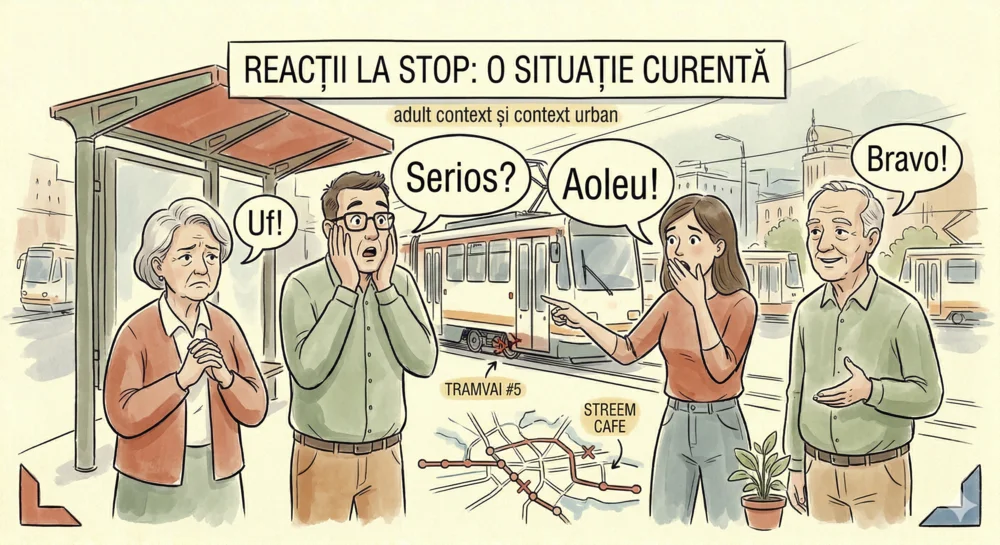
The Vibe
`B1_U13` adds live reactions to conversational speech. You learn not only to answer grammatically, but to sound like a person in a real situation: react, support, sigh with relief, praise, or doubt.
Do not learn interjections as a flat list. Connect each one to emotion, scene, and intonation.

| Reaction | Emotion | Scene | Example |
|---|---|---|---|
| Vai! | surprise / compassion | bad weather, news, problem | Vai, ce frig e! |
| Aoleu! | alarm / sudden problem | forgotten keys, pain, mistake | Aoleu, am uitat cheile! |
| Uf! | relief / tiredness | after effort or stress | Uf, am terminat. |
| Bravo! | praise | success, good answer | Bravo, ai reușit! |
| Serios? | surprise / checking | unexpected news | Serios? Nu știam. |
| Mda... | reserve / mild disappointment | not convinced | Mda... nu sunt sigur. |
With a short high tone, it is surprise. With a soft tone, compassion. With a pause, disappointment.
Use it for a sudden problem: forgotten ticket, pain, mistake, bad news.
It fits after stress, waiting, or effort: `Uf, în sfârșit!`
It is not a direct `no`, but a signal: I am not sure, not fully convinced, doubtful.
B1 starts when the reaction is followed by a short explanation: `Serios? Nu știam asta.`
Short, higher voice, quick continuation.
Slower, softer, often with a pause.
It does not argue directly, but shows distance.

`Aoleu` can sound very lively, but if you use it too often, speech becomes comic. For a neutral reaction, `Vai`, `Serios?`, `Uf`, or a short reasoned phrase is often safer.
The exercises work with emotion and context: match reaction to scene, tone choice, comic bubbles, dialogue repair, and voice-message response.
Repeat not only the words, but the intonation: alarm in `Aoleu`, checking in `Serios?`, exhale in `Uf`, praise in `Bravo`, doubt in `Mda...`.
The cards here depend strongly on audio: the goal is not only to remember the translation, but to hear the emotional gesture.
Record a 30-40 second voice message: a small problem happened, you react, explain the situation, and find a solution. Use at least 4 reactions.
Match each reaction with the right scene
What feeling does each reaction convey?
This exercise type is not yet supported by the reader.
type: multiple_choice
Add natural reactions to the blanks
A: Aoleu! Vai! Serios? Uf! Uf! Am pierdut autobuzul! Aoleu, ce problemă mare! B: Serios? Serios? Serios? Următorul vine peste zece minute.
Choose the right reaction for each situation
The text is overloaded with reactions. Make it more natural
Aoleu! Vai! Serios? Uf! Am uitat portofelul acasă. Aoleu, ce problemă mare!
Choose the right reaction for each context
Each reaction carries a different feeling. Sort them by emotional type
Record a short message: you are late, explain why, react to the problem, and suggest a solution
1.You are late to meet your friends.
2.Explain what happened.
3.React naturally with an interjection.
4.Suggest a solution.
Practice saying this out loud.