intră
entered
Perfectul simplu for reading and narration
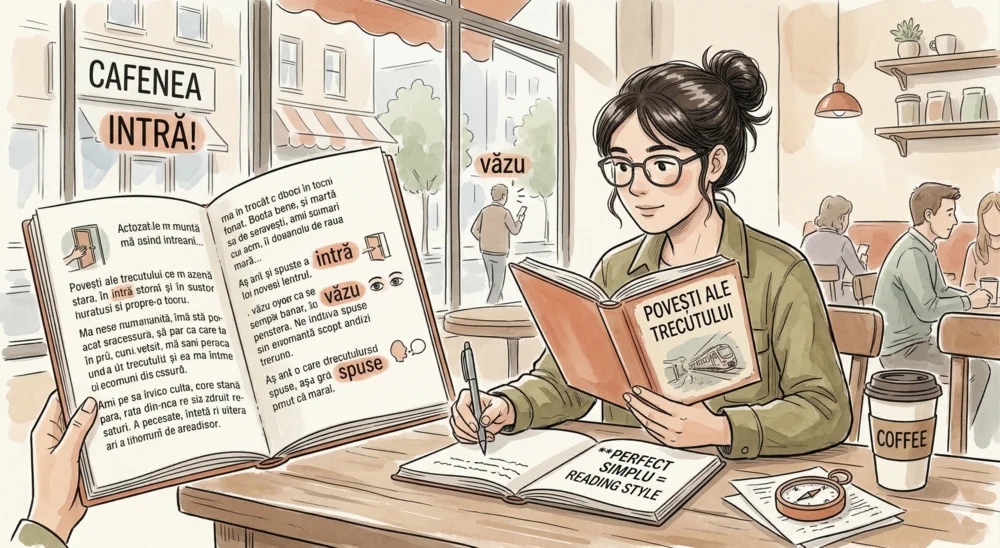
The Vibe
`B2_U04` teaches you to read narrative past. You see `intră`, `văzu`, `înțelese` and quickly map it to ordinary meaning: `a intrat`, `a văzut`, `a înțeles`.
Main strategy: do not try to speak this way immediately. First learn to recognize the form quickly and map it to familiar `perfect compus`.
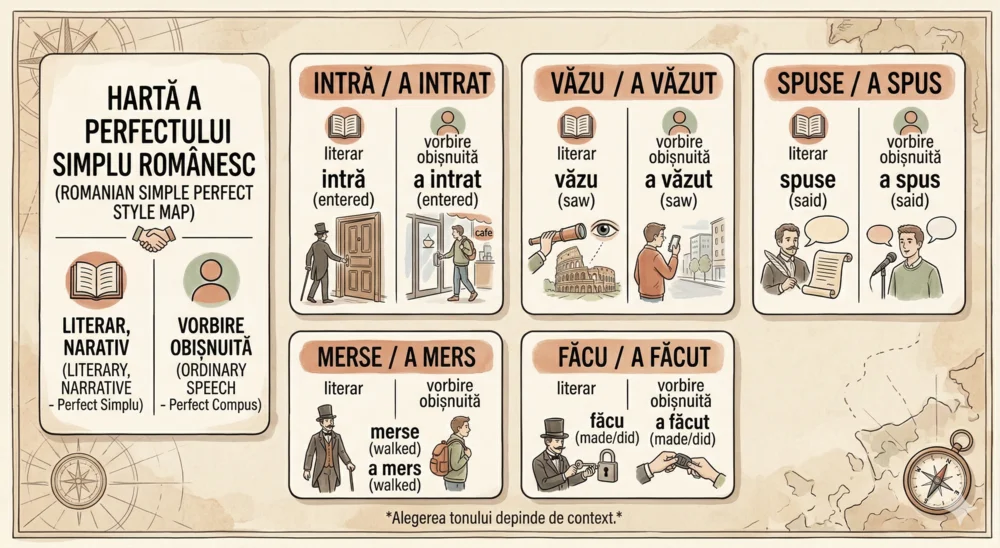
| Perfect simplu | Perfect compus | Verb | Style |
|---|---|---|---|
| intră | a intrat | a intra | narrative |
| văzu | a văzut | a vedea | literary |
| spuse | a spus | a spune | narrative |
| merse | a mers | a merge | literary |
| făcu | a făcut | a face | narrative |
| înțelese | a înțeles | a înțelege | literary |
`văzu` does not mean a special kind of seeing; it is completed `a văzut` in narrative style.
Perfectul simplu often appears in sequences: `intră, privi, văzu, înțelese`.
`intră` can look like present, so past context is critical.
In ordinary conversation, `a intrat`, `a văzut`, `a spus` is usually safer.
In some regions perfectul simplu is more alive in speech, but this course prioritizes reading first.
Usually several short completed actions appear in a row.
This helps you understand the meaning quickly.
Why did the author choose this form: pace, literary tone, historical voice?

Listen to pairs and repeat the second form as ordinary speech. The goal is to instantly connect `văzu` with `a văzut`, `spuse` with `a spus`.
Perfectul simplu is especially visible in literature and in some regional speech varieties, for example in Oltenia. In the B2 learning path, we treat it primarily as a reading skill.
10 tasks: spotting, matching, transformation to perfect compus, style labels, short reading notes, and controlled narrative rewrite.
Repeat the narrative as reading aloud, not as ordinary conversation. Track the rhythm of the chain: `intră, privi, văzu, deschise, citi, înțelese`.
20 cards for recognizing narrative forms and quickly mapping them to perfect compus.
Take a short narrative fragment: mark perfectul simplu forms, rewrite it in perfect compus, and add 3 reading notes about style.
Match simple past forms with their modern compound past equivalents.
Find all simple past (perfectul simplu) forms in the text.
Rewrite the fragment, replacing simple past with compound past for everyday speech.
El intră în cameră și văzu scrisoarea. O deschise și citi mesajul.
Identify the style of each form: literary, everyday, or regional.
Personajul intră, văzu și înțelese.
El a intrat, a văzut și a înțeles.
Merse spre gară și întrebă un trecător.
By ear, sort forms: simple past or compound past.
Put actions in the correct chronological order.
Read the fragment and write 3 notes: which perfectul simplu forms appear, how they map to perfect compus, what style they create.
`se opri`, `privi`, `spuse`, `începu` sunt forme de perfect simplu. În perfect compus: `s-a oprit`, `a privit`, `a spus`, `a început`. Textul sună literar și narativ.
Select the correct statements about the function of perfectul simplu at B2 level.
Write 4-5 sentences in narrative style using at least 5 perfectul simplu forms. Then rewrite them in perfect compus.
Practice saying this out loud.
Read a short fragment aloud in story style. Then retell the same fragment in ordinary speech with perfect compus.
Practice saying this out loud.